Safety and Reliability
Reliability answers a conditional question: under which conditions does this system keep working?
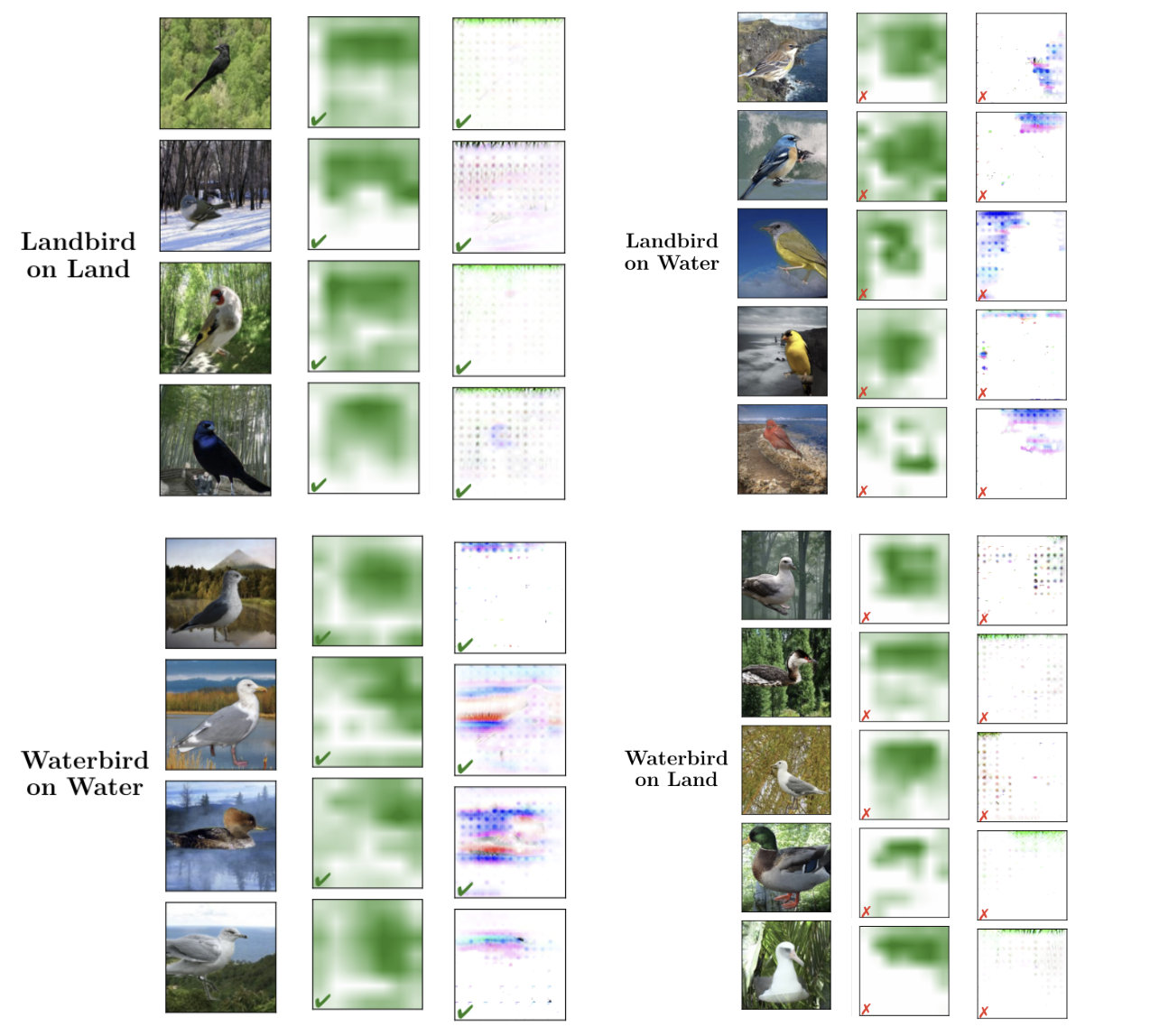
A bird classifier may be excellent when waterbirds appear on water and landbirds appear on land. That test set rewards a shortcut. Move a waterbird onto a beach or a landbird near a pond and the relationship between label and background breaks.
This is a distribution-shift problem. The deployment environment contains combinations that were rare or absent in training. A model that learned the animal may generalize. A model that learned the scenery may collapse.
Stress-Test the Background
This bird classifier can use the animal's shape or the scene behind it. Increase deployment shift to send more waterbirds onto land backgrounds and landbirds onto water backgrounds.
Expected deployment accuracy
50%
Waterbird
on water
score = 0.65(1) + 0.80(1) = 1.45
predicts waterbird
Waterbird
on land
score = 0.65(1) + 0.80(-1) = -0.15
predicts landbird
Landbird
on water
score = 0.65(-1) + 0.80(1) = 0.15
predicts waterbird
Landbird
on land
score = 0.65(-1) + 0.80(-1) = -1.45
predicts landbird
Safety adds consequence. A mistaken playlist recommendation is annoying. A mistaken speed-limit reading can change how a vehicle behaves. A medical triage error can delay care. The same technical failure deserves different controls in different settings.
Explanations help teams form and test hypotheses about failure. If a saliency method points to the background, create counterexamples with swapped backgrounds. If the model appears sensitive to a one-pixel artifact, remove or vary that artifact. If a language model follows instructions hidden in retrieved documents, test the tool boundary and permission model.
A single explanation is weak evidence. Reliability comes from repeated tests across realistic conditions, monitored after deployment.
A bird classifier is accurate on familiar backgrounds and poor on swapped backgrounds. What is the strongest conclusion?