Superposition and Interference
Only vectors can be perfectly orthogonal in dimensions. A model that packs more features into the space must reuse directions that overlap. When one feature activates, it creates a small false signal along another direction. That is interference.
Interference
For normalized feature directions and , the dot product measures overlap. Zero means orthogonal. Larger absolute values mean more cross-talk.
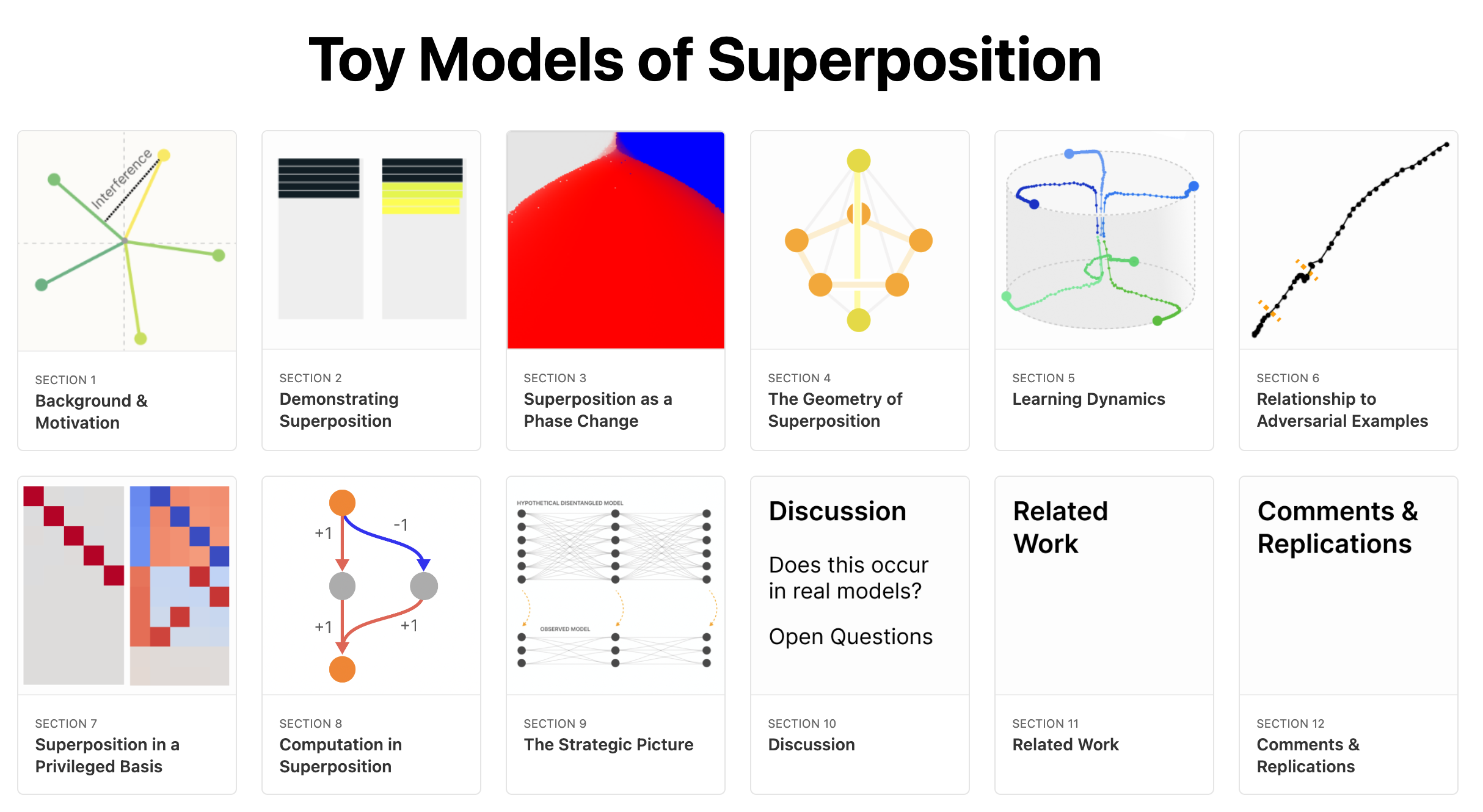
Create a Feature Collision
Change the angle between a rare fraud feature and a travel feature. When travel activates, overlap creates a false fraud signal.
Direction overlap
0.71
False fraud signal
0.71
Interference can explain brittle behavior. A rare fraud feature may overlap with a common travel feature, causing occasional false positives. The model accepts that cost if the extra representational capacity improves average loss.
Why does sparse feature activation make interference more tolerable?
The superposition hypothesis says models represent more features than they have dimensions by placing features in almost-orthogonal directions. In a toy two-dimensional model, important dense features may get clean axes. As feature sparsity rises, additional directions appear around the circle.
An -dimensional space can contain only perfectly orthogonal directions, but high-dimensional spaces can contain many more directions that are nearly orthogonal. If most features are sparse, the model can tolerate occasional interference in exchange for representing many more useful features.
That is why sparse features matter. Most images do not contain dog heads, most images do not contain a curve at one exact orientation, and most tokens do not refer to pizza. Rare features collide less often.
Capacity tradeoff
Superposition is worthwhile when the performance gained by representing extra sparse features exceeds the loss caused by interference between their directions.
Pack More Features Than Dimensions
This toy model has two dimensions. Increase feature sparsity and it becomes worthwhile to pack more feature directions into the same space.
Dimensions
2
Features kept
7
Pairwise angle
51°
Interference
0.325
At low sparsity, features often co-occur and need clean axes. At high sparsity, collisions are rare enough that extra capacity wins.
This hypothesis explains why scaling neurons alone does not guarantee neuron-level interpretability. A larger model may use the extra capacity to represent even more features. Resolving the mixture requires an overcomplete feature basis rather than a longer list of neuron labels.
A dense model tends to keep only the most important features cleanly. As features become sparser, the model starts using superposition: less important features overlap first, then more important ones are pulled into the geometry as the capacity tradeoff changes.
The visual diagnostics include feature-vector norms, cosine similarities, and feature-by-feature matrices. A norm near one suggests a feature is represented; overlap in the matrix shows where features share directions and create interference.
Pack 20 Features Into 5 Slots
Select a feature below, then click a bin to place it. There are only five bins for twenty features — some bins must hold more than one. Darker features matter more to the model; lighter features are less important.
Features placed
0 / 20
Bins available
5
Most crowded bin
0
In the lab, why does the model keep more features as sparsity rises?
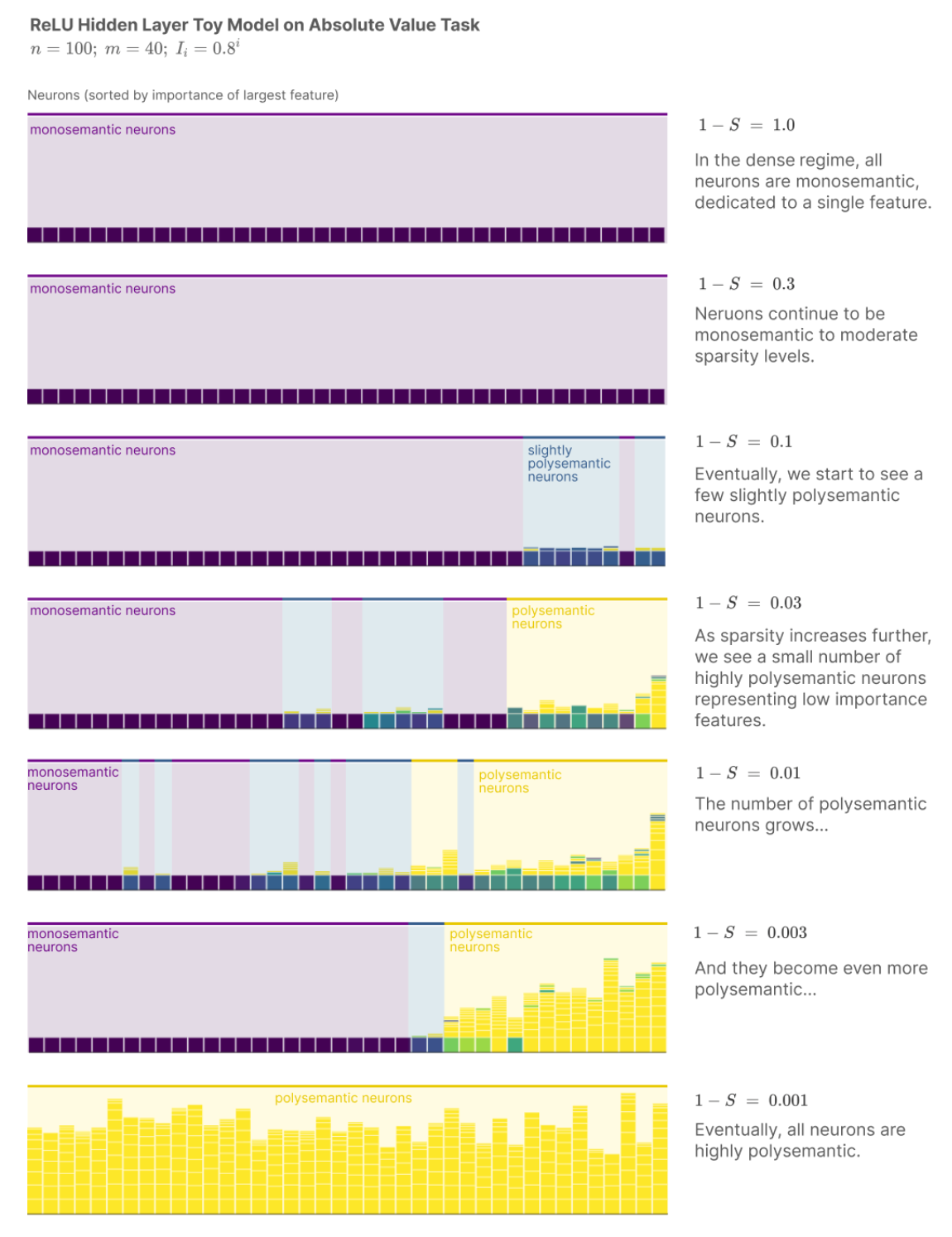
Neuron-based explanations assume the model's coordinate axes line up with meaningful concepts. Superposition breaks that assumption. A feature may use many neurons, and one neuron may support many features.
The axis is convenient for us. Training had no obligation to make it semantically tidy.
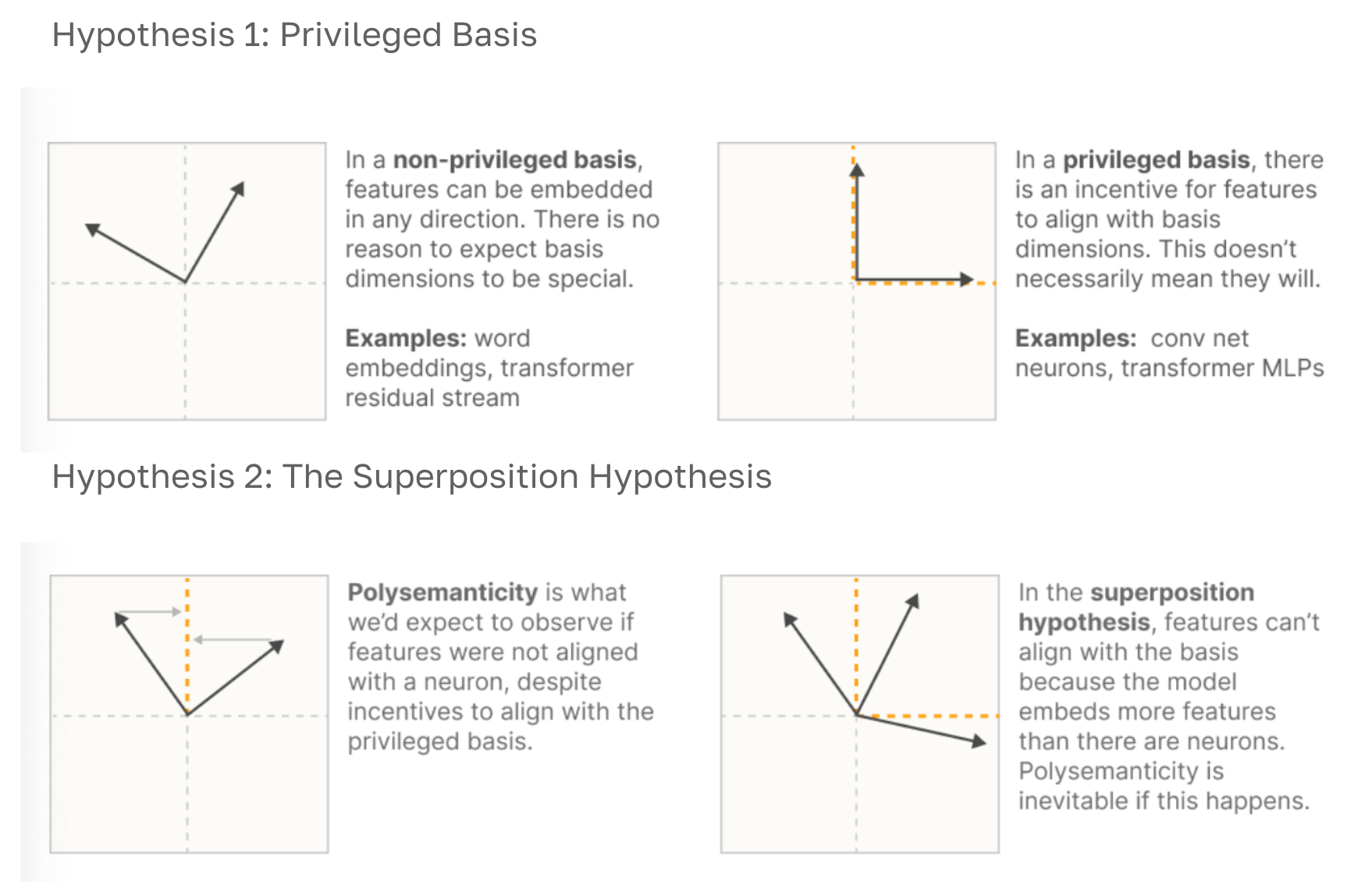
Privileged basis
A basis is privileged when the architecture or optimization gives features an incentive to align with its coordinate axes. ReLU and sparsity can create some alignment, but they do not guarantee one feature per neuron.
How to resolve superposition? 3 hypotheses:
- Create models that avoid or reduce superposition.
- Find an overcomplete basis that recovers the features inside a model that uses superposition.
- Use hybrid approaches that make models easier for a second interpretability stage to analyze.