Overview
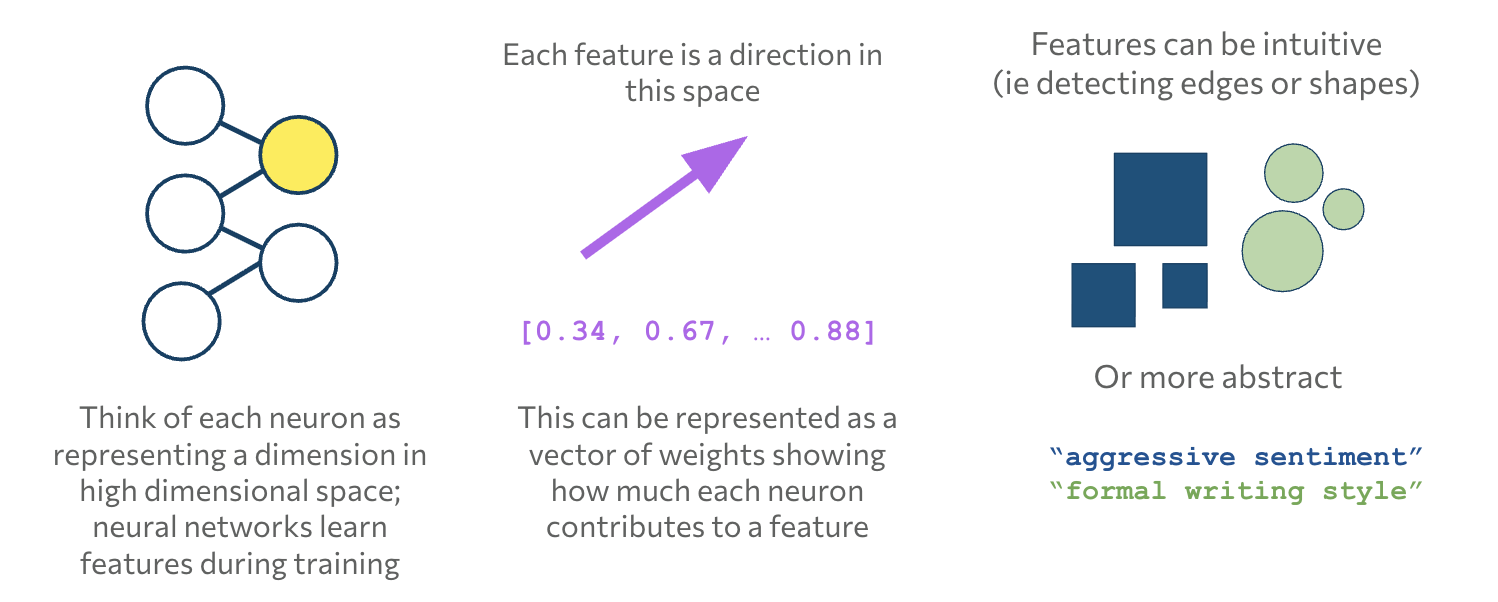
The raw input “Labrador” is a token. Inside a model, it can activate several properties at once: capitalized word, proper noun, dog breed, and likely subject of the sentence. Those internal properties are features.
A feature is useful because later computations can read it. The model does not need an English label for “dog breed.” It needs a stable internal signal.
Feature
A feature is a meaningful, potentially decodable property represented in a model's activation space. It may describe the input, the current context, or a computation in progress.
Mix the Meaning of “Labrador”
The same token can carry several internal properties. Adjust the context signals and watch downstream readers receive different feature mixtures.
0.80×0.35 + 0.45×0.65
0.80×0.1 + 0.70×0.9
0.80×0.25 + 0.70×0.35 + 0.45×0.4
Mix several meanings carried by the token “Labrador” and see which downstream readers use each one.
Feature labels are analyst shorthand. A feature called “Python list variable” may also respond to tuples or array notation. Before a security team builds a monitor around it, they need examples where it fires, examples where it stays quiet, and a causal test showing that changing it affects the behavior of interest.
Why should a feature label be treated as a hypothesis rather than a ground-truth name?