Mechanisms
A neural network already has a computational graph: matrix multiplications, nonlinearities, attention heads, residual additions, and output projections. A mechanistic circuit is a task-relevant slice of that much larger graph.
The residual stream complicates the picture because many components read from and write to the same shared state.
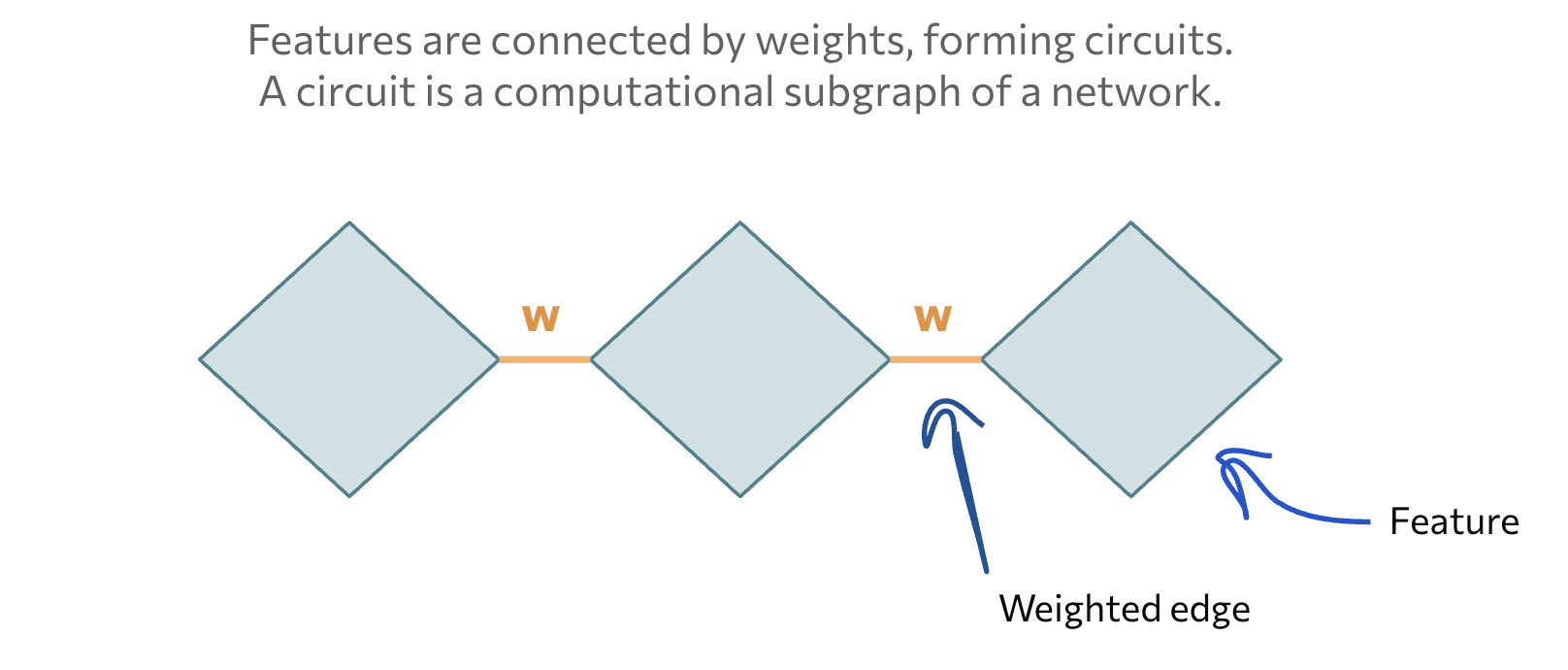
Nodes and edges
Nodes represent intermediate quantities such as feature activations or attention-head outputs. Directed edges represent how one quantity contributes to another, often with a signed weight.
Circuit discovery starts from a behavior narrow enough to test. “How does the model answer factual questions?” is too broad. “How does it complete ‘The Eiffel Tower is in’ with ‘Paris’?” gives you a clean output score and a manageable set of runs.
Discovery workflow
Choose a behavior, define a metric, identify candidate components, prune weak paths, and validate the remaining subgraph with interventions and controls.
Prune an Invoice Circuit
Raise the edge threshold to remove weak paths from an invoice detector. Watch the explanation become smaller while behavioral fidelity eventually falls.
edge 1
0.62
edge 2
0.48
edge 3
0.31
edge 4
0.17
edge 5
0.09
edge 6
0.04
Edges retained
4 / 6
Circuit fidelity
1.00
Automation can rank thousands of components, but the metric decides what the tool finds. A circuit optimized for exact-token recovery may miss a mechanism that preserves meaning through a synonym. Match the metric to the real behavior you care about.
Why should circuit discovery begin with a narrow behavioral metric?
Consider the sequence “A B ... A”. A useful next-token strategy is to look back for the earlier A, notice that B followed it, and predict B again. Transformer researchers call this pattern induction.
An induction circuit often uses one head to mark previous-token relationships and another to copy the token that followed a matching prefix.
Induction pattern
An induction head attends from the current token to an earlier matching token and moves information about that earlier token's successor toward the output.
Trace an Induction Head, Hop by Hop
An induction circuit needs two hops: find where the current token last appeared, then look one position after that match. Step through both hops to see why the mechanism needs a previous-token head and an induction head working together.
Hop 1 · previous-token head
Current token “Gandalf” last appeared at position 3.
Hop 2 · induction head
Shift attention one position forward from the match, to “raised.”
Copy forward
Write “raised” toward the output. Predicted next token: raised.
Induction helps models continue repeated names, code patterns, and formatting templates. It can also copy mistakes or malicious text from context. Understanding the mechanism gives developers a way to test when context copying dominates factual recall or instruction following.