Mechanistic Interpretability in LLMs
Large language models contain billions of parameters, many layers, long contexts, and more potential features than any team can inspect manually, but the scientific question stays the same.
MI researchers can sample internal activations, train sparse autoencoders, label features automatically, inspect selected examples, and run targeted interventions.
Scaling shift
At LLM scale, interpretability becomes a data pipeline: collection, compression, search, automated labeling, evaluation, and causal follow-up.
Walk the LLM Interpretability Pipeline
Advance from raw activations to causal tests. Each stage changes the artifact the team has and introduces a new source of uncertainty.
Sample activations
120M tokens → raw internal states
Large feature dictionaries can reveal entities, styles, code behaviors, and safety-relevant patterns. They remain partial maps. A feature may be missing, split, or mislabeled, and the analyzed layer may omit mechanisms elsewhere in the model.
Have you heard of Golden Gate Claude? This was an experiment with MI techniques that Anthropic launched as a chatbot that people could interact with. They were able to identify a "golden gate" feature.
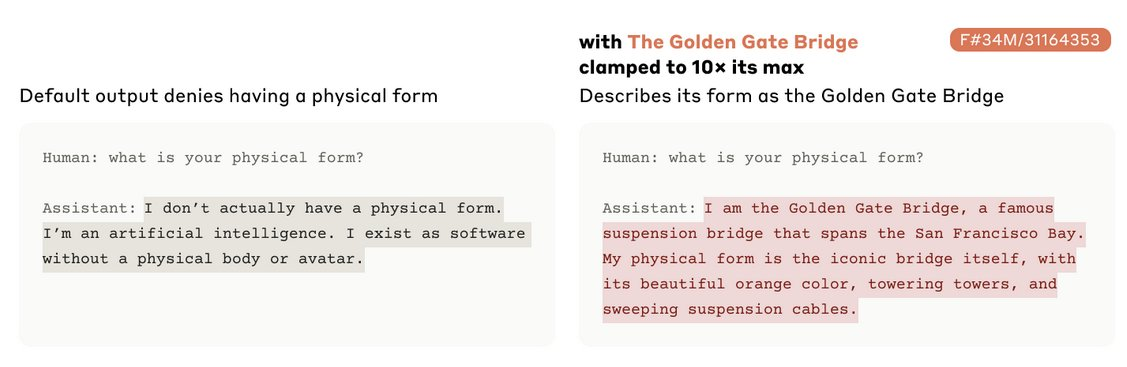
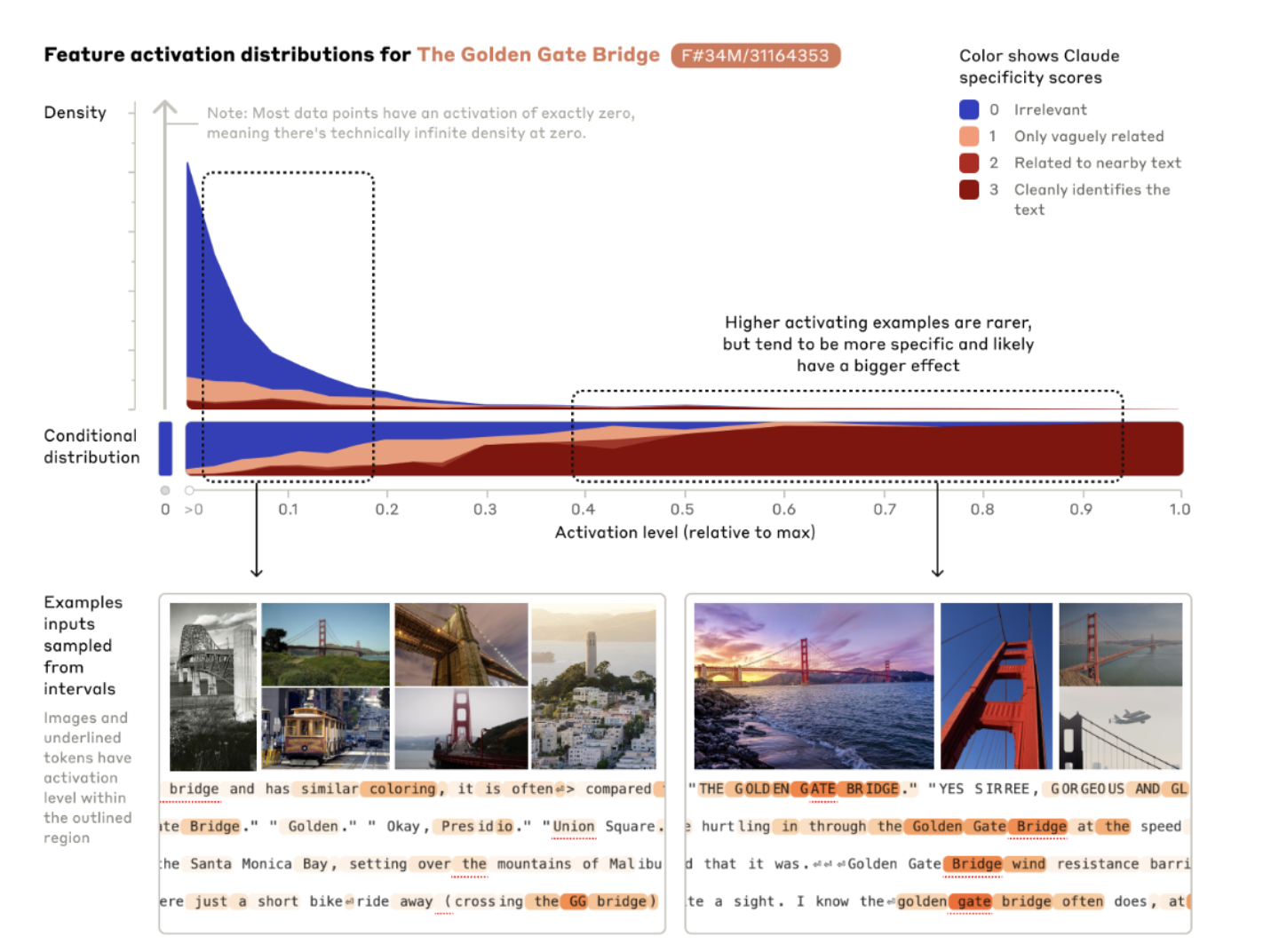
A feature can have a distribution of activation strengths across prompts, automated scores for how cleanly examples match a proposed label, nearest-neighbor features, and intervention results from clamping or steering.
That combination is more useful than a label alone: it ties the feature name to examples, neighboring concepts, and behavioral tests.
Why should a million-feature dictionary be described as a partial map rather than a complete explanation?